
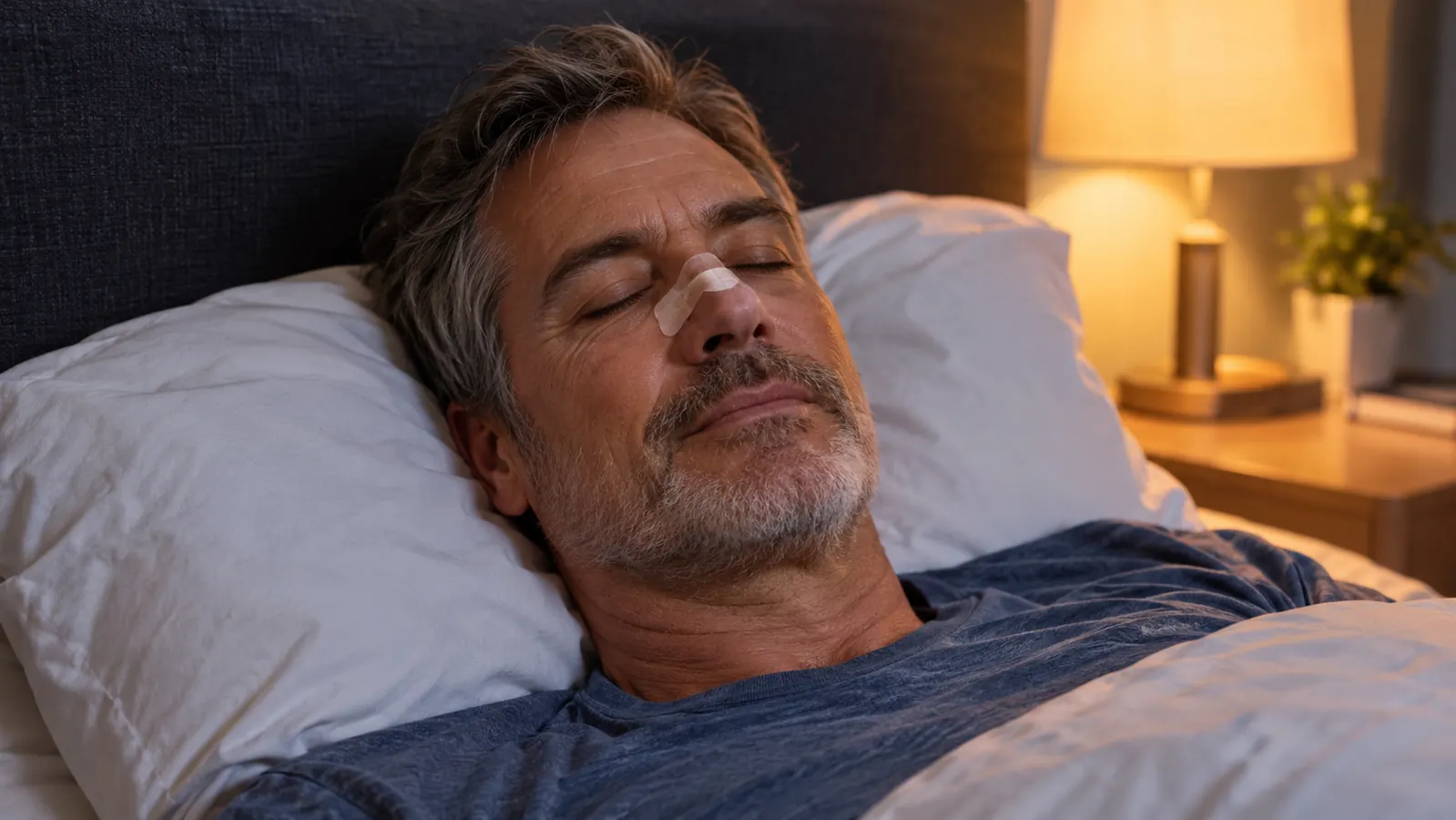
There is a specific kind of tired that comes from a stuffy nose at 2 a.m. You are exhausted, your mouth is dry, and every breath sounds like a small animal trying to get out of a paper bag. I have been that man more nights than I can count. I am Wendell Graves, 59, a retired electric utility lineman who spent thirty years working the lines outside Knoxville, Tennessee, and I have snored loud enough to send my wife Darlene to the couch for twenty years. Two years ago a sleep study showed I have moderate obstructive sleep apnea, so I use a CPAP every night. But a CPAP does not fix a stopped-up nose, and a stopped-up nose will ruin the best mask fit in Tennessee. That is where Breathe Right nasal strips come in, and after about eight months of using them, I have some plain-spoken thoughts on how to make them actually work.
The short version: Breathe Right Extra Strength strips are the first thing I reach for on a stuffy night, and they do what the box says. They open your nose from the outside, which sounds odd until you feel it. The flexible spring-like bands are 50% stronger than the standard strips, and they pull the sides of your nose outward so the airway stays open while you sleep. They are not a cure for snoring, and they are not a treatment for sleep apnea. If you snore loudly, or if someone has noticed you stop breathing at night, get a sleep study. A strip is a comfort tool, not a diagnosis. But for a stuffy nose that keeps you up, it is the difference between mouth-breathing all night and actually getting some air. I bought my first box with my own money, the first week of March this year, and I have kept a box on the nightstand ever since.
Stuffy nose ruining another night?
The Extra Strength strips open your nose from the outside with spring-like bands that are 50% stronger than standard strips. I keep a box on the nightstand.
Amazon Check Today's Price on Amazon →Step 1: Start with a clean, dry nose
The biggest mistake I made at first was slapping a strip on a sweaty, oily nose after a hot shower. It peeled off by the time I turned out the light. Now I wash my face with plain soap and water, dry it with a towel, and wait about a minute before I put the strip on. The adhesive needs a clean, dry surface to grab. If your nose is slick with lotion or moisturizer, the strip will not stay, and a strip that curls up at 3 a.m. is worse than no strip at all.
I also learned to dry the bridge of my nose specifically. A lot of guys dry their whole face and miss the spot right between the eyes. Run the towel across the bridge a couple of times. That little patch of skin is doing all the work.
The first box I bought, the first week of March this year, I made every mistake in one night. I had just stepped out of a hot shower, my face was still damp, and I slapped the strip on without drying off. By the time I pulled the covers up it was already curling at the ends. I pressed it down again, turned out the light, and within twenty minutes I felt it peel loose against the pillowcase. I lay there in the dark holding it to my nose with two fingers, which is not a long-term strategy. The next morning I read the box like it owed me money and started over with a clean, dry face. That night it stayed put until my alarm went off at 6:40, and I have done it the same way ever since.
One more thing: if you use a CPAP like I do, put the strip on before you put on the mask. The strip sits on the bridge of your nose, and the mask cushion needs to seal around it. It takes a minute to get the fit right, but once it seals, the combination is a lot more comfortable than a mask alone on a stuffy night.
Step 2: Peel the backing off the right way
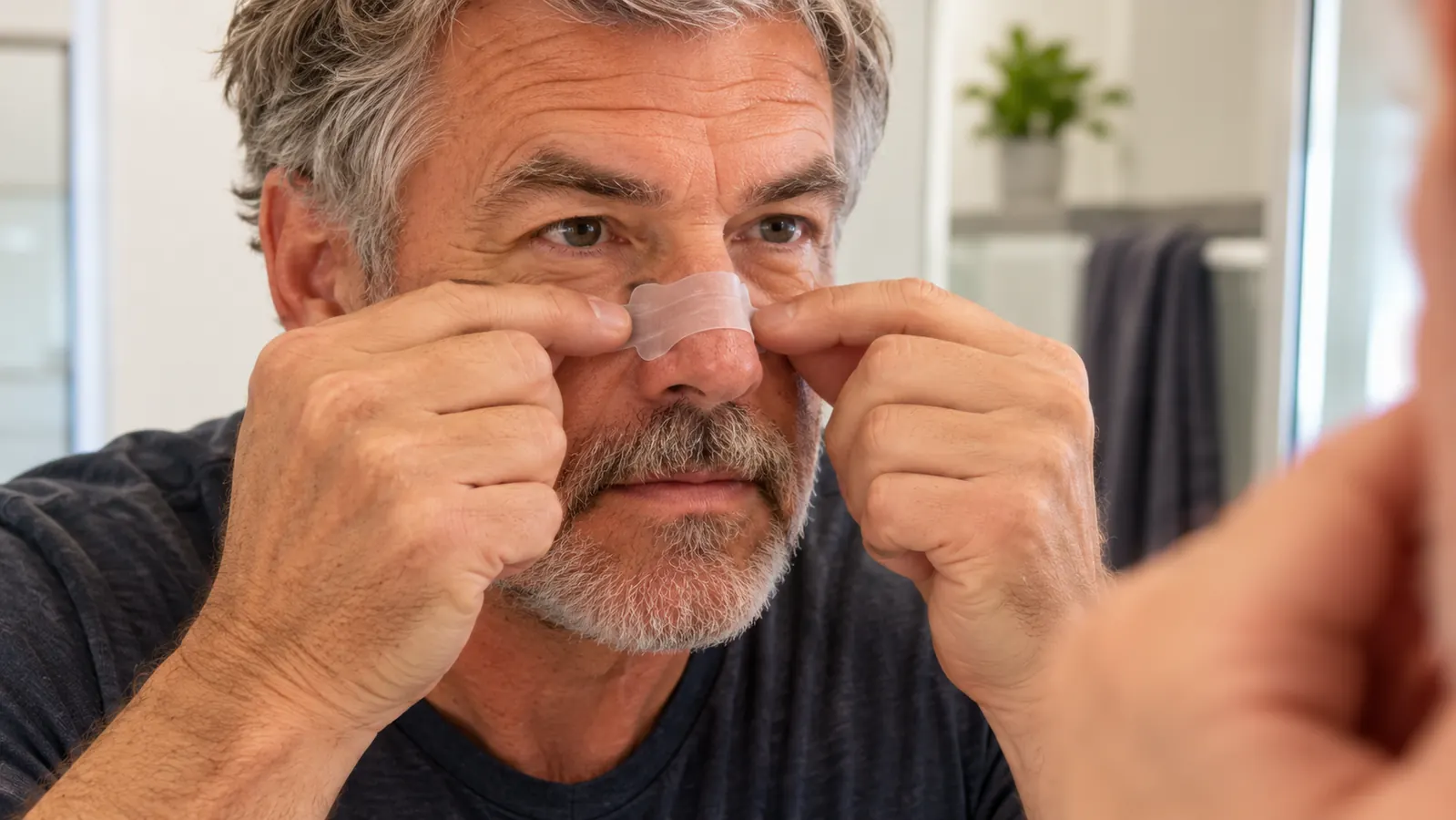
The Breathe Right strips come with a clear plastic backing that peels off in two pieces, one from each side. The trick is to peel one side, position the strip on your nose, then peel the other side while the first half is already stuck down. If you peel the whole backing off before you touch your nose, the strip folds in on itself and sticks to your fingers. Then you are fighting a sticky mess at bedtime.
I peel the left side first, press it gently onto the bridge, then peel the right side and press that half down. It takes about five seconds and the strip lies flat instead of bunching up. These are the Original Clear strips, so they are hypoallergenic, flexible, and non-porous, made with 3M materials. They are clear enough that Darlene says she barely notices it, which is high praise from a woman who notices everything.
Step 3: Place it high on the bridge, not low
Placement matters more than anything. The strip needs to sit across the widest, stiffest part of your nose, just below the bony bridge, where the cartilage starts to flare. If you put it too high, it does nothing because the bone will not flex. If you put it too low, it pulls on the soft tip and feels like a clothespin.
The right spot, for me, is with the wide center of the strip sitting right at the midpoint of my nose, and the two ends wrapping down the sides. When I press the ends firmly against the sides of my nose, I can feel the spring-like bands engage. That is the feeling you are after: a gentle outward pull, not a squeeze.
The first few nights I placed the strip too high, up on the hard bony part of my nose, and it did nothing except make me look like I was wearing a tiny seatbelt. The cartilage does not move up there, so the strip just sat there doing no work. Then I tried it too low, right at the tip, and it pulled the soft part of my nose down and made the stuffiness feel worse than before. The sweet spot for me is about a quarter of an inch below the hard ridge, where the nose starts to widen. When I hit it, I can feel the air move differently on the very first breath. That sounds like a small thing, but at 2 a.m. it is the whole ballgame.
Press the whole strip down with your fingertips for about ten seconds. Pay extra attention to the ends, because that is where the strip does its work. If the ends are not stuck down, the strip is just a decoration.
Step 4: Give it a minute before you lie down
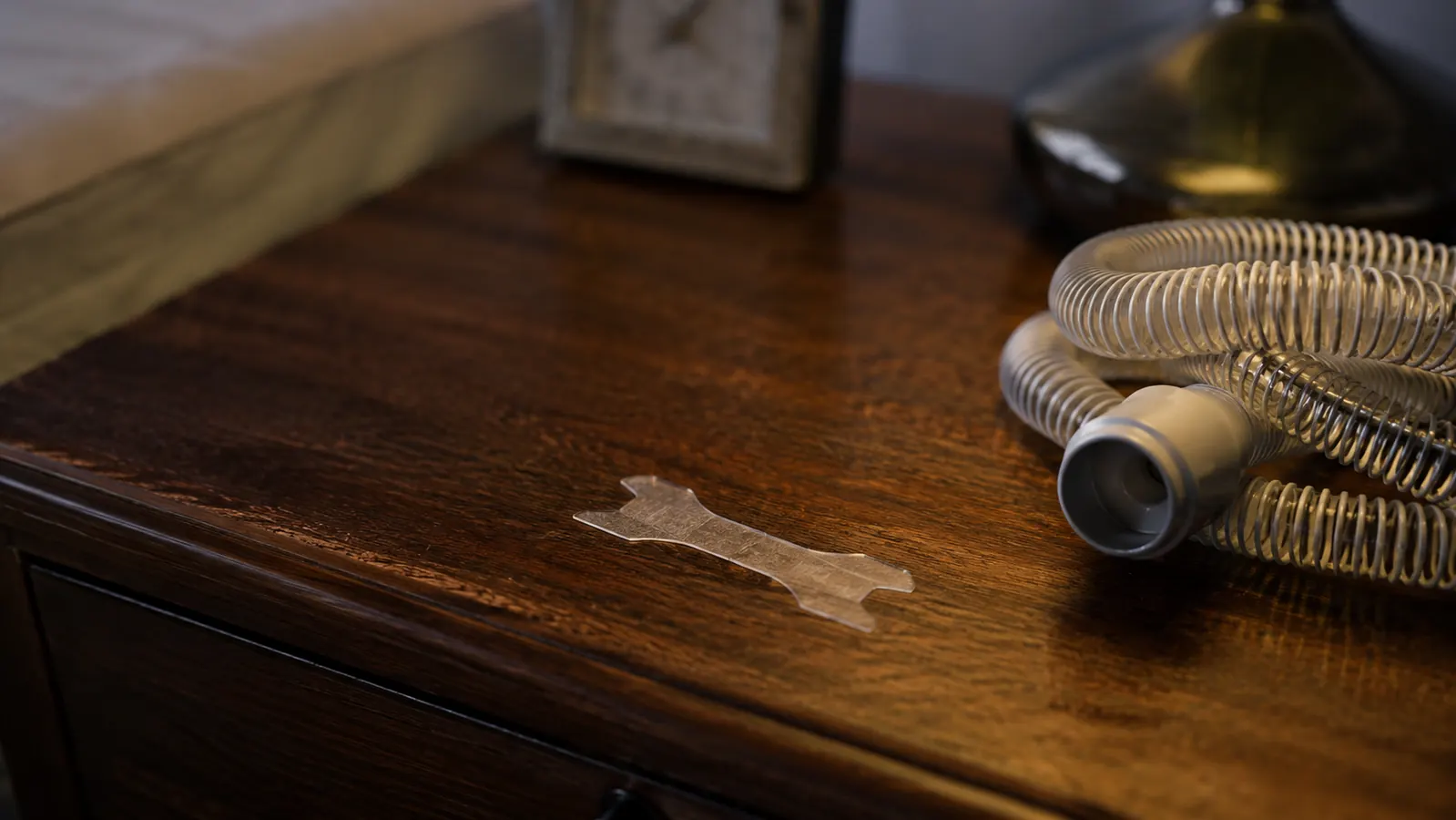
I used to put the strip on and immediately drop onto the pillow. The adhesive had not bonded yet, and the friction of the pillowcase pulled it loose. Now I put the strip on, brush my teeth, and let it sit for a minute or two before I get into bed. That gives the adhesive time to set.
One night in October I was in a hurry. Darlene was already asleep, the clock on the dresser was ticking past midnight, and I put the strip on and dropped straight onto the pillow. Ten minutes later I was awake, fishing the corner of the strip off my cheek where the pillowcase had dragged it. I got up, washed my face, dried the bridge of my nose, put on a fresh strip, and stood at the bathroom sink brushing my teeth for a full two minutes before I went back to bed. It stayed put all night. That is the whole lesson: the adhesive needs time to grab, and the pillow is the enemy of a fresh strip.
If you sleep on your side like I do, the pillow will rub against the strip all night. A strip that has had a minute to bond will survive that. A strip that is fresh and loose will not. This is also the moment to check the fit in the mirror. If it looks crooked, peel it off and start over with a fresh one. They are not designed to be reused, and a re-stuck strip never holds as well.
Step 5: Take it off gently in the morning
In the morning, do not yank the strip off like a bandage. I peel from one end, slowly, holding the skin on the side of my nose with my other hand. It comes off clean and leaves no sticky residue. These are made with 3M materials, and the adhesive is strong enough to stay put all night but not so strong that it hurts to remove.
The morning after my first successful night, I made the other mistake: I ripped the strip off fast, the way you pull a bandage. It did not hurt much, but it left the skin on the side of my nose pink for an hour, and Darlene asked what on earth I had done to my nose. Now I peel slow, from the left end, and I hold the skin down with two fingers of my other hand. It comes off in one piece, no residue, no red mark. The box says these are made for sensitive skin, hypoallergenic and non-porous, and after eight months of use in the spring and fall, I believe it.
If you have sensitive skin, this matters. The Original Clear strips are hypoallergenic and non-porous, which I think is why I have never had a red mark or a rash. I have used other strips that left my nose feeling raw by morning. These do not.
I toss the used strip in the trash and put the box back on the nightstand. The box is about 1.5 x 4.49 x 6.77 inches and weighs 1.45 ounces, so it does not crowd the lamp and the CPAP. A 44-count box lasts me a good while, since I only use them on nights when my nose is stuffy, which is maybe three or four nights a week in the spring and fall.
What Else Helps
A strip is one tool, not a whole plan. I run a small humidifier in the bedroom from November through March, and I fill it with a gallon of distilled water every other night, because dry winter air makes a stuffy nose worse before the strip ever gets a chance. I sleep with an extra pillow when my allergies act up, which in east Tennessee is basically April through June and again in September. And I use my CPAP every single night because my doctor prescribed it for moderate obstructive sleep apnea. The strip helps the CPAP work better on stuffy nights because it keeps my nasal passages open, which means less mouth-breathing and a drier mouth in the morning. If you snore heavily, or if your partner says you stop breathing, please do not buy a box of strips and call it handled. See a doctor and get a sleep study. Sleep apnea is a medical condition, and only a doctor can diagnose and treat it. A strip is a comfort tool. The sleep study is the real fix.
The strip helps the CPAP work better on stuffy nights because it keeps my nasal passages open, which means less mouth-breathing and a drier mouth in the morning.
I have also learned that Breathe Right strips work best when I do not think of them as a snoring cure. They are a nasal congestion tool. My snoring did not stop the first night I wore one. It got quieter, and my mouth was less dry, but the snoring was still there, because the snoring was tied to the apnea. The CPAP is what fixed the snoring. The strip is what makes the CPAP tolerable on a stuffy night. When my nose is clear, I sleep better, and Darlene sleeps in our bed instead of the couch. That alone is worth the price of a box.
Keep a box on the nightstand for stuffy nights
Extra Strength strips with 50% stronger spring-like bands, made for sensitive skin with 3M materials. I buy the 44-count box and it lasts me for weeks.
Amazon Check Today's Price on Amazon →