

Here is the short answer, because I know that is what you came for: the Breathe Right Extra Strength strip stayed put on my nose every single night for eight months, and the internal nasal dilator worked loose twice in that same stretch. So if the question is which one stays put, the strip wins for me. But the dilator is not a bad product, and for some people it is the better buy. It depends on your skin, your nose, and whether you can stand anything stuck to your face while you sleep.
Let me tell you who is talking. I am Wendell Graves, 59 years old, a retired electric utility lineman who snored loud enough to send my wife Darlene to the couch most nights for years. Two years ago she noticed me stop breathing in my sleep. My doctor sent me for an overnight sleep study, and I came home with a diagnosis of moderate obstructive sleep apnea and a prescription CPAP, which I have worn every night since. I bought both of these products myself in the first week of March, with my own money, and I have used each one for about eight months. Everything in this comparison comes from that testing. And before we go further, the part I will say more than once: snoring can be a sign of sleep apnea, and sleep apnea is a medical condition only a doctor can diagnose and treat. No strip, dilator, or gadget replaces a sleep study or a prescribed CPAP.
| Breathe Right Extra Strength Strips | Mute Internal Nasal Dilators | |
|---|---|---|
| How it opens your nose | Flexible "spring-like" bands pull the nostrils open from the outside, with relief that starts the second the strip touches skin | A small silicone tube sits inside each nostril and holds the airway open from within |
| Stays put overnight | The adhesive held through every night of my eight-month test, even when I rolled onto my side | Stayed in place most nights, but worked loose twice when congestion was at its worst |
| Skin sensitivity | Hypoallergenic and made with 3M materials for sensitive skin, but it is still an adhesive on your nose | No adhesive touches your skin at all, so there is nothing to irritate |
| Cost per night | One strip per night, then it is gone | One pair lasts for months with regular cleaning |
| Visible on your face | You can see the strip in the mirror | It sits completely inside the nostril, so nothing shows |
| Best for | People who want instant relief and do not mind an adhesive | People with oily skin or a mustache who cannot keep adhesive stuck |
How I Tested Them
I tested both products the same way, on the same queen bed, in the same bedroom I share with Darlene. Each one went on about thirty minutes before lights out, and I kept a spiral notebook on the nightstand. Every morning I wrote down whether the product was still in place, whether I breathed through my nose or my mouth overnight, and how dry my mouth felt when I woke up. I also wore each one under my CPAP mask, because that is how I actually sleep, and I figure that is how a lot of you will use them too. I gave each product a fair shot, which means I did not switch back and forth every night. I wore the strip for two weeks straight, then the dilator for two weeks straight, then I rotated. That way the honeymoon phase of a new gadget could not fool me.
Darlene kept her own notes from the other side of the bed, and they were simpler than mine. Did I snore? Did I roll onto my back? Did I rip the thing off at 2 am and throw it on the floor? That last one happened exactly once, with the dilator, and I will get to that. Eight months is a long test, long enough for a honeymoon period to wear off and for the truth to show up. The notebook matters more than it sounds, because memory plays tricks on you in the middle of the night.

Where Breathe Right Wins
The strip wins on the question this article is named after, which is staying put. The Extra Strength version uses flexible "spring-like" bands that are 50% stronger than the standard strips, and that tension is what held it to my nose all night. I am a side sleeper. I toss. I have woken up with the strip exactly where I put it, night after night. The adhesive never irritated my skin, and I have sensitive skin, so that surprised me. The specs say these are hypoallergenic and made using 3M materials, and in my case that held up.
It also wins on speed. The product description promises "instant nasal congestion relief," and that is the one time the label did not oversell. The second the band grabs the sides of my nose, I can take a deeper breath through that nostril. That matters at 11 pm when I am already in bed and stuffed up. With the dilator I had to fiddle with it, wet it, and seat it just right before it did anything. With the strip I press it on and I am done in five seconds. When you are tired and congested, five seconds versus a minute of fiddling is a real difference.
The strip is also the easier product to use with a CPAP. I put my mask on over the strip and the combination worked from the first night. The strip holds my nose open, the mask does its job, and I wake up with a far less dry mouth than I used to. I will be honest that I cannot tell you whether the strip is officially made for CPAP use, because the label does not say that. I can only tell you that it worked for me, every night, for eight months.
Where Mute Wins
The Mute internal dilator wins on skin contact, and that is a bigger deal than it sounds. There is no adhesive anywhere on your face. That makes it the right answer for people with oily skin, people with a mustache, and people whose skin turns red and raw after a few nights of any adhesive. My own skin handled the strip fine, but I know plenty of people who cannot wear anything stuck to their nose. For them, the dilator is the better product, and I would not argue with that choice for a second.
It also wins on being reusable and invisible. One pair of dilators lasted me for months with regular cleaning, while a strip is one night and done. Over eight months, that adds up. And because the dilator sits completely inside the nostril, nobody can see it. I wore one to the grocery store once just to test that, and Darlene did not notice until I pointed at my nose. The strip is subtle, but you can see it in the mirror. If that matters to you, the dilator has the edge.
Now the part I have to be honest about. The dilator worked loose twice in eight months, and once it came out completely at about two in the morning. I woke up, felt around for it on the pillow, and spent ten minutes looking for a tiny piece of silicone in a dark bedroom. That is the trade-off. It sits inside your nose, which is why nothing shows and nothing sticks to your skin, but inside your nose is also where it can slip. It never happened with the strip.
The strip that stayed put for eight straight months
Breathe Right Extra Strength strips open your nose the second they go on, with "spring-like" bands 50% stronger than standard, and they stayed put on my nose every night of testing. A 44-count box covers more than six weeks of nightly use.
Amazon Check Today's Price on Amazon →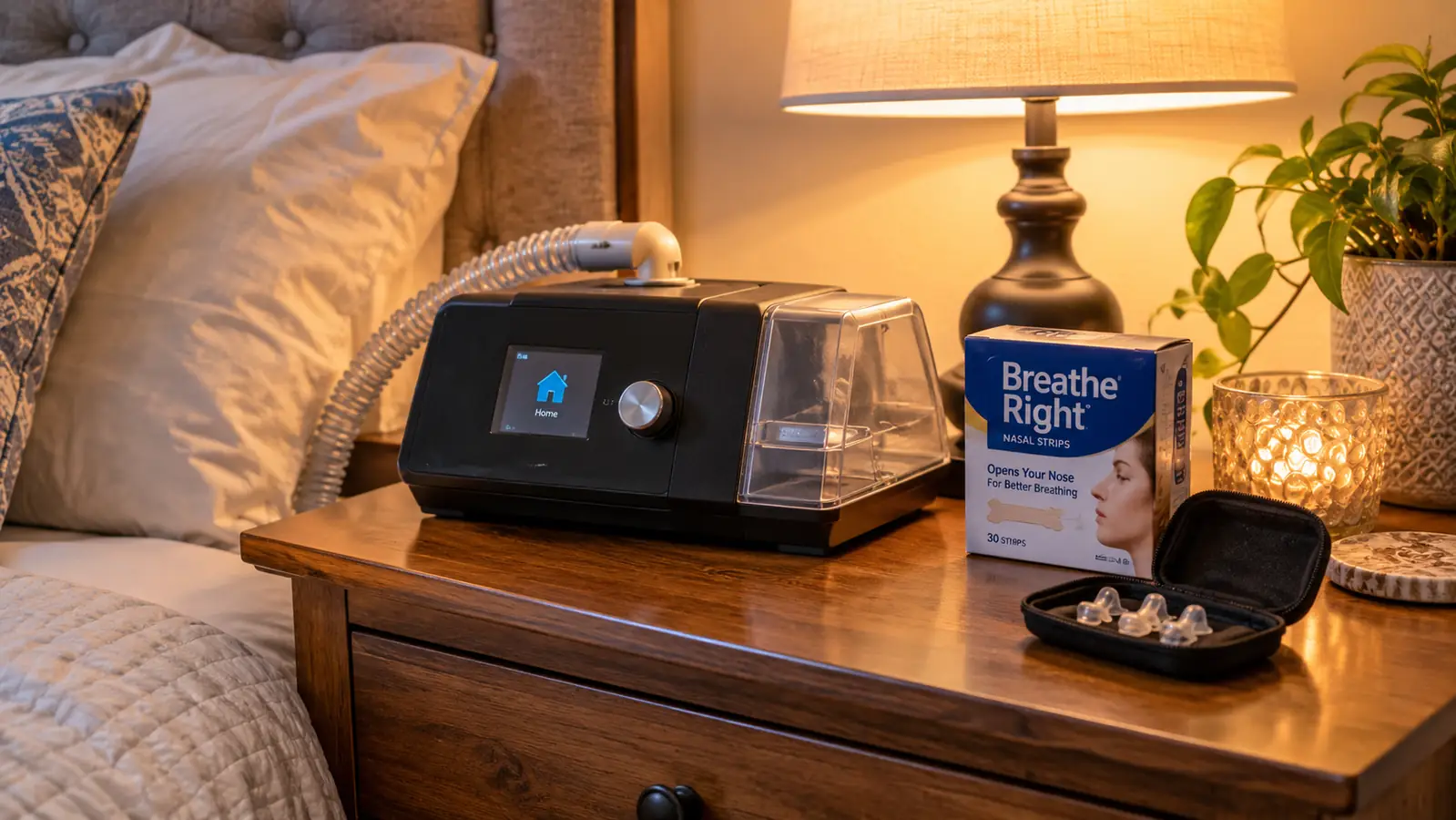
What It Feels Like to Wear Each One
The feel is where these two products really split. The strip is a constant, gentle pull on the outside of your nose. You know it is there, but after the first few nights you stop noticing it. It is a little like wearing a bandage. The first time I wore it, I thought the tension might bother me, but I fell asleep faster than I expected, and by week two I forgot I had it on until I touched my nose in the morning.
The dilator is the opposite. You feel it inside your nostril, and for me that feeling never fully disappeared. It is not painful, and it is not uncomfortable exactly, but it is present. If you have ever worn earplugs that you could feel all night, it is that same low-level awareness. Some people love that because it means the thing is working. I just never got fully used to it. That is a personal thing, and your nose may be different, but it is the honest truth of my eight months.
The CPAP Question
I said I would not tell you what to do with your medical equipment, and I meant it. What I can tell you is what I did. I wear my CPAP every night, and I added the strip on top of it. The two worked together from night one. The strip held my nose open, which cut down the mouth breathing that was drying out my throat, and my mask sealed fine over it. I have read that some people use dilators under a nasal mask instead. I tried that too. It worked, but the mask pushed on the dilator and I could feel it shift. The strip never shifted.
If you use a CPAP and you are thinking about trying either of these, the honest advice is to ask your equipment provider or your doctor before you add anything to your setup. What worked for me might not work for you, and your mask, your pressure, and your nose are all different from mine. I can only give you my experience: the strip played nice with my CPAP, and the dilator worked but felt less stable under the mask.
Who Should Buy Which
Buy the Breathe Right strip if you want something that works the instant you put it on, stays put all night, and does not mind an adhesive on your nose. That is most people. It is certainly every CPAP user I know. Buy the internal dilator if your skin rejects adhesive, if you have a mustache, if you want something invisible, or if you would rather clean a reusable piece of silicone than throw away a strip every morning. Both of those are honest answers, and neither is wrong. If you are still on the fence, start with the box of strips. It is the easier way to find out which camp you are in, and if you hate it, the dilator will still be waiting at the store.
And if you snore, please hear me one more time. Snoring can be a sign of sleep apnea, and sleep apnea is a medical condition that only a doctor can diagnose and treat. A strip or a dilator might help you breathe easier at night, but neither one is a treatment for sleep apnea. My CPAP is what treats mine. Talk to your doctor, get the sleep study if they recommend it, and use these products for what they are: comfort aids that helped me breathe through my nose at night.
Eight months later, the strip is still on my nightstand
I bought my first box of Breathe Right Extra Strength strips in March, and I have been reordering them ever since. The dilator is still in my drawer for nights when my nose needs a break from adhesive, but the strip is what I reach for. Check the current price on Amazon and see if it works as well for you as it did for me.
Amazon Check Today's Price on Amazon →