
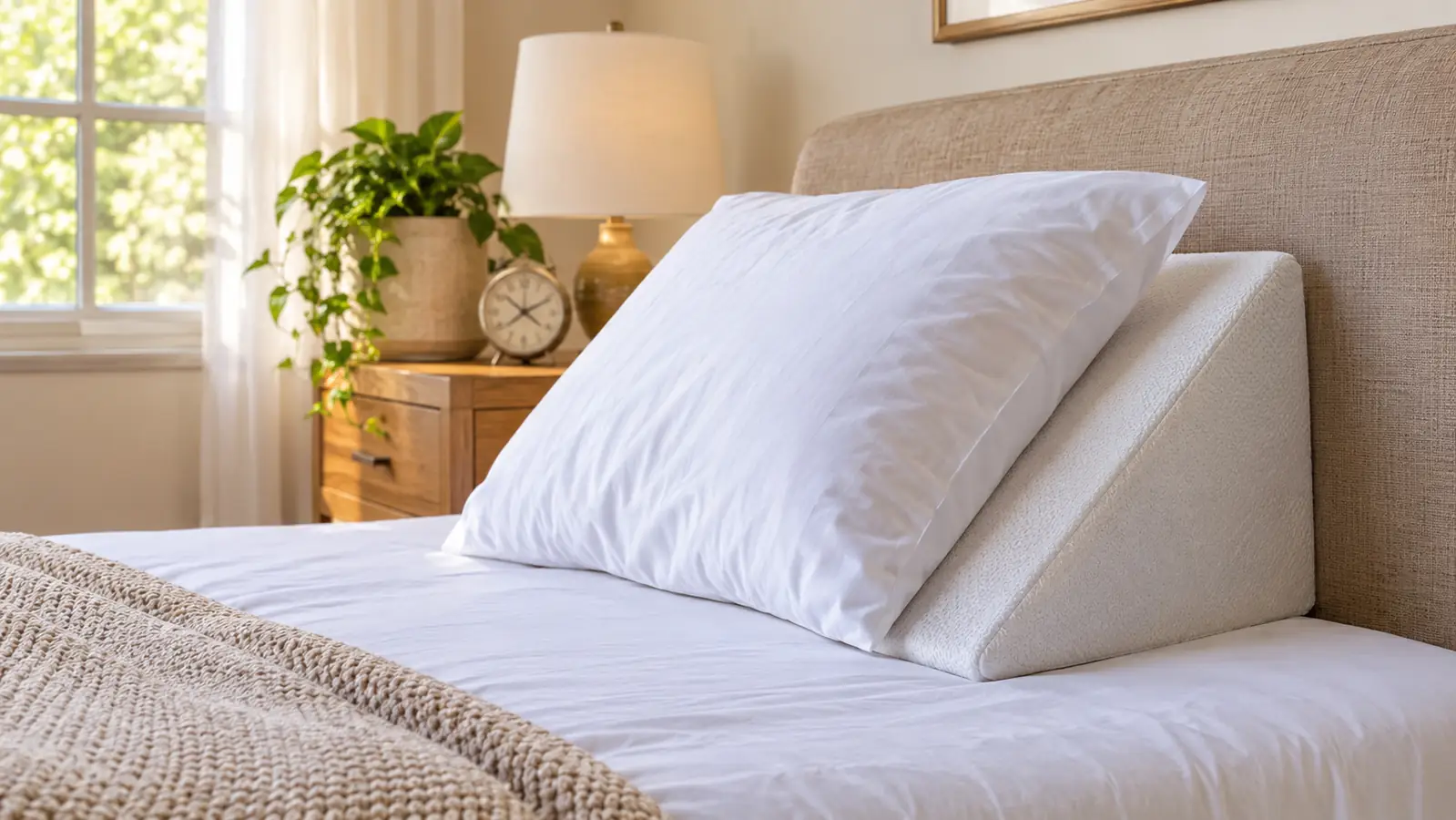
I bought the Vekkia wedge pillow back in March, the same week my doctor reminded me that my CPAP only works if I actually use it, and that I use it better when I'm not fighting my pillows all night. I'm a back sleeper with moderate sleep apnea, and for years I propped myself up on three lumpy pillows that slid apart by midnight. The Vekkia wedge pillow changed that, but only after I figured out how to set it up right. The first two nights I had it backwards, the third night it slid down the bed, and the fourth night I finally got it right. Here's exactly how I'd set it up on a queen bed if I were doing it over.
The wedge pillow I've used every night since March
The Vekkia 32-inch extra-long wedge pillow covers more of the bed than the shorter wedges I tried, and the 7.5-inch height works for me whether I'm reading or sleeping. Check today's price on Amazon before you decide.
Amazon Check Today's Price on Amazon →Step 1: Give the foam 48 hours to puff up
The Vekkia wedge pillow arrives vacuum-packed, and the box tells you to wait 48 hours for the foam to fully puff up and get firm. I did not wait. I ripped it open that first evening around eight o'clock, put it on the bed, and slept on a wedge that felt like a firm marshmallow with a soft spot in the middle. By morning it had flattened a little where my shoulders pressed, and I figured I'd wasted my money. I measured it that next morning, and the tall end had dropped from the 7.5 inches printed on the box to about six and a half, with a dent right where my shoulder blades had been. Darlene took one look at it and asked, gently, whether I wanted to send it back. I slept on it anyway that second night, telling myself it would break in. That was exactly backwards. The foam needed time to expand, not pressure to soften.
The next night I took it off the bed, leaned it against the wall in the spare room, and left it alone for two full days. I'll admit I checked on it a couple of times, pressing the foam with my thumb to see if anything was changing. By the second evening it had rounded out, and the dent was gone. When I put it back on the bed, it was a different piece of foam: firmer, taller, and it held its shape all night. I measured it again, and the tall end was right at 7.5 inches, the full height the box promised. If you're setting this up for the first time, do the boring thing and wait. Unpack it in the morning, let it sit somewhere out of the way, and make your bed with it that second evening. The 48 hours are not a suggestion. The foam needs every one of them, and the difference between night one and night four is the difference between a lumpy disappointment and a pillow you'll keep.
Step 2: Put the tall end at the headboard
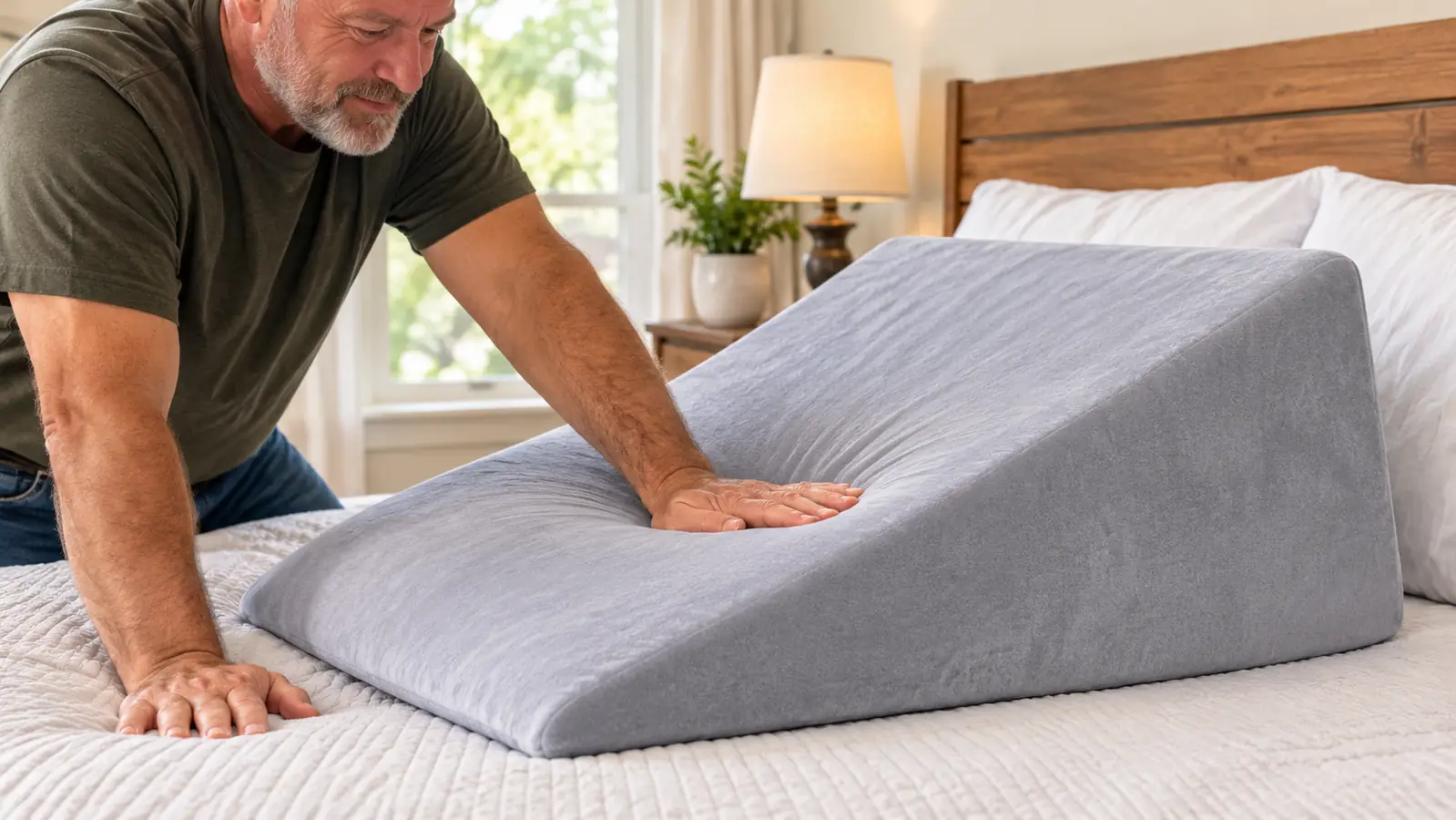
This sounds too simple to need saying, but I had it wrong for two nights. The Vekkia wedge pillow is 32 inches long, 22 inches wide, and 7.5 inches high at the tall end, and the tall end belongs at the headboard. I had the tall end at my feet the first night, which meant my head was barely raised and my knees were up around my chest. I woke up with a dry mouth and a sore neck, and I blamed the pillow. The second night I tried laying it sideways, with the 32-inch length running from the headboard down the bed, and that was somehow worse: I was stretched out on a narrow ramp, my left arm went numb, and I gave up around 2 a.m. and tossed it onto the floor. When Darlene found me asleep on a regular pillow with the wedge on the rug, she asked, not unkindly, whether it was supposed to be a bed or a boat ramp. She had a point. I was treating the wedge like a mattress topper when it's really a ramp, and ramps have a right way and a wrong way.
The fix was embarrassingly simple. Turn it around so the 7.5-inch side is against the headboard and the slope runs down toward the foot of the bed. On a queen bed, the 32-inch length runs across the bed, and the 22-inch depth gives you a comfortable slope from your lower back to your head. That orientation is the whole ballgame. Once I had it right, my CPAP mask stayed sealed, my airway stayed open, and I stopped waking up gasping. I also stopped waking up with that sandpaper dry mouth, because my head wasn't tilted back at a weird angle anymore. The first morning I slept the whole night on it, I told Darlene I felt like I'd finally figured out the one thing everybody else seemed to know by instinct. Darlene slept through that whole night, which was its own kind of proof. She's a light sleeper, and a night without her getting up to move to the couch is a good night.
Step 3: Pin it in place with a flat sheet and your body weight
The first night I had the Vekkia wedge pillow oriented correctly, it slid six inches down the bed by 2 a.m. I know the time because I woke up with my head in the gap between the wedge and the headboard, and my CPAP mask had pushed up against my nose. The 100% polyester cover is smooth, and smooth means slippery against a smooth fitted sheet. I fixed it with two things I already owned: a flat sheet and my own weight. But before I landed on that, I tried two things that failed. First, I put a rubber shelf liner under the wedge, the kind Darlene uses in the kitchen cabinets. It held for about an hour, then the wedge slid anyway and took the liner with it. Then I tried tucking the fitted sheet in tighter, which did nothing, because the problem was the wedge sliding on top of the sheet, not the sheet sliding on the mattress.
Pull the flat sheet up tight over the wedge, tuck it under the mattress at the headboard, and let the rest of the sheet lie over you. The sheet adds grip between the wedge and the bed, and your body weight on the lower part of the wedge holds it in place. If you're a back sleeper like me, the 22-inch depth means your hips rest on the lower slope, and that's enough to keep the whole thing from migrating. If you're a side sleeper, wedge a regular pillow behind your back so you don't roll off the slope. I also learned to stop yanking the covers up hard when I climb into bed, because that pulls the wedge toward my feet. Now I reach down, grab the bottom edge of the wedge, and tug it back against the headboard before I settle in. It takes two seconds, and I haven't woken up in the gap since that third night. Darlene brought home a non-slip rug pad a few days later, and I tried it out of politeness. It helped, but the flat sheet worked just as well and didn't add another layer to wash.

Step 4: Use the built-in side pockets for the things you reach for at night
The Vekkia wedge pillow has a built-in side pocket on each side, and those pockets are not a gimmick. I keep my phone in the right pocket and my CPAP remote in the left pocket, and I no longer have to fumble on the nightstand in the dark. Darlene, my wife, keeps her reading glasses in the other pocket when she sits up with me for a while before she falls asleep.
The pockets are sewn into the side panels, so they don't interfere with the slope of the foam. They're deep enough to hold a phone without it sliding out when you shift in your sleep, and they're positioned so you can reach them without lifting your head off the pillow. It's a small thing, but it makes the wedge feel less like a medical device and more like a piece of furniture that happens to help me breathe at night.
Step 5: Put the removable cover on and wash it on a schedule
The Vekkia wedge pillow comes with a removable cover, and the cover has a soft velvet side panel that feels gentle against your skin. I'll be honest: I didn't wash mine for the first six weeks, and by then it needed it. A wedge pillow sits right where you sweat, drool, and breathe all night, and the cover is the part that takes the punishment. The foam core stays clean because the cover comes off. When I finally unzipped it that first time, I was a little embarrassed at the stain on the velvet panel where my cheek had rested every night, and the faint smell that came off it. Darlene didn't say a word, which somehow made it worse. I washed it that same morning, and it came out looking like new. The stain came out with a little oxygen bleach and a good rinse.
I wash the cover every two weeks now, on the same day I wash the sheets. It zips off in about a minute, goes in the washing machine on cold, and air-dries on the back of a chair by evening. I learned not to put it in the dryer, because the velvet panel comes out wrinkled and the zipper end shrinks a little, which makes it a fight to get back on the foam. The foam core itself never goes in the washing machine, and I never fold or bend it when I move it. I pick it up flat, carry it like a board, and set it down on the bed. If you take care of the cover, the wedge itself should last a long time. Mine has been on the bed every night since March, and the foam still holds its 7.5-inch height at the tall end. The zipper still runs smooth, the velvet panel still feels soft, and the pockets haven't stretched out of shape. That's after eight months of nightly use, which is a better report than I can give for most of the gadgets I've tried.
What Else Helps
A wedge pillow is not a treatment for sleep apnea, and I don't want to sound like it is. Snoring can be a sign of sleep apnea, and sleep apnea is a medical condition that only a doctor can diagnose and treat. No pillow, strap, or strip replaces a sleep study or a prescribed CPAP. I learned that the hard way: I spent years buying gadgets that promised to stop my snoring, and the only thing that actually fixed my breathing at night was the CPAP my doctor prescribed after my sleep study two years ago.
What the Vekkia wedge pillow does is make the CPAP easier to tolerate. It keeps my head and shoulders elevated, which keeps my airway more open and reduces the pressure I need. It also keeps me from rolling onto my back in a way that collapses my airway. If you're waiting for a sleep study, or if you're adjusting to a CPAP, a wedge pillow is a reasonable thing to try, but it's a complement to medical care, not a substitute for it.
The only thing that actually fixed my breathing at night was the CPAP my doctor prescribed. The Vekkia wedge just made the CPAP easier to live with.
Set yours up tonight and give it a week
The Vekkia wedge pillow took me four nights to get right, and now I don't sleep without it. If you're tired of waking up with a dry mouth and a sore neck, check today's price on Amazon and see if it works for you.
Amazon Check Today's Price on Amazon →